
Reflecting on Reflections
On what turns play into play therapy

(An audio file in case you prefer to listen instead of reading)
I’ve been thinking about reflections lately. Those seemingly simple words said aloud during a play therapy session.
A reflection, at its most basic, is a statement that mirrors back what the therapist is observing or sensing in the child’s experience. It is not a question, not an interpretation, and not a direction.
It might reflect what the child is doing or what is happening in the play: “You put all the animals on this side.”
It might reflect and name feelings: “You are working really hard to put those two together and it feels frustrating”.
It might reflect the body and sensation: “Your legs know just how to move with the beat of the drum”
It might name the child’s emotion or state: “It feels really good to win.” or “There is a lot of energy in your body that wants to empty all those baskets onto the floor.”
It may name the therapists perception, emotion, or body sensation: “I feel like I can’t do it right. Like someone knows all the answers and no matter how hard I try, I just can’t understand”.
Or it might stay entirely inside the metaphor: “The wolf is hunting again. He never gets to rest.”
The more I think about reflections, and all the ways we can use them in session, I can see their power. I would even venture to say: Reflections are what turn play into play therapy.
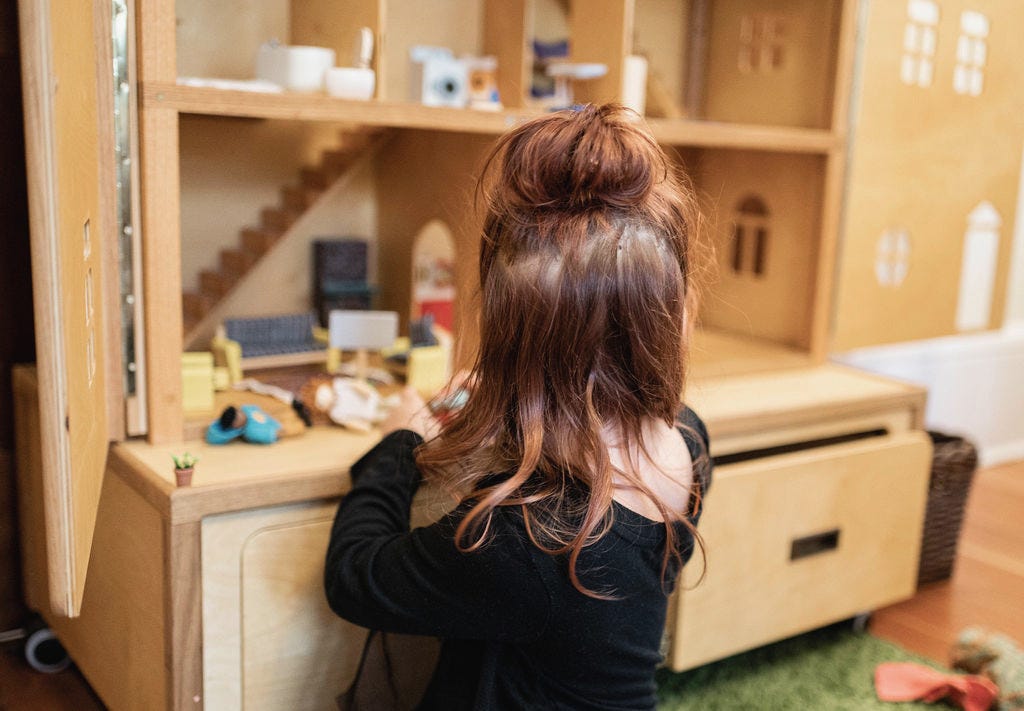
In consultations, we frequently discuss how caregivers, or other professionals, perceive what we do in sessions as just playing. And, from experience, I know that this thought can also arise in the play therapist from time to time. “I’m just playing soccer with this child”.
To the untrained eye, play therapy actually can look like an adult and a child just playing. But, there is so much more going on.
Set scene: I am sitting on the floor near the child. There is an ambulance and a fire truck in between us. He’s searching through a pile of little, plastic people looking for the child figurine and a dog.
I say “You need that boy in the blue shirt and a dog for your story.” He says “Yah, because the kid is the one that watches to make sure there are no fires starting”. I move my body so that I am laying on the floor on my stomach. There is silence for a few moments. He keeps looking in the pile. I say “I notice the softness of the carpet and also the hardness of the floor under my body”. He says nothing in response but starts to fiddle with the ladder on the fire truck, clipping it together. I say “Ah, you got it.” And then he turns to place pieces of fluffy, orange and red carded wool inside the playhouse. They are curling out the windows. The child figurine he found is standing on the top of the fire truck, tiny binoculars nearby, and he starts to respond with urgency to the flames in the home. A thought arises in me: “It is a lot of pressure for that child to be in charge of a whole house fire and have the responsibility for managing it, alone. I save that thought because it’s not time to say it yet. The moment will come, after the scene has become more developed, and the story expressed enough times, when those potent words become the medicine this child needs to hear.
Reflections are nuanced. They consider and affect many facets of a play therapy session and relationship. It is saying the most helpful thing, at the right time, which requires the therapists attunement and trust of her inner knowing. It sounds simple. Just say things that are happening. It is actually very layered.


Reflections are relational. They happen inside our therapeutic relationship, and they can deepen it. When a child hears themselves reflected accurately, something registers: this person is paying attention. This person sees me. That experience of being seen is deeply therapeutic. They can slowly settle in to the knowing that they can bring their full, authentic self in the room and it is welcome.
Reflections guide the session. Not through direction, thought or agenda, but through attention. What the therapist chooses to reflect, and what they let pass, can quietly shape where the therapeutic work goes.
Reflections facilitate processing. They can slow the child’s material down enough for it to be metabolized. A child in the midst of urgent, activating play may need a single quiet reflection to help their nervous system slow down and integrate what is being expressed. They can make the implicit, what is being expressed in metaphor, into an explicit articulated concept or knowing. This can facilitate processing and transform repetitive play.
Reflections shift a child’s self concept. When a child who has only heard you are too much, too loud, too angry hears instead there is a lot of energy in your body, of course you are angry, you can play with this in any of the ways that you want, that is not just reframing. It is a new relational experience landing in their system.
Reflections are neuroscience. They facilitate right hemisphere to right hemisphere communication. A well-attuned reflection is not just heard, it is felt. It arrives through tone, timing, and resonance as much as through words.
Reflections invite embodiment. They can bring both the child and the therapist back into the body, into regulation and into the present moment. Refections can name sensation, texture, temperature, or breath.
Reflections are reparative. For a child who has rarely felt seen or understood, a consistent experience of being reflected back to themselves truthfully repairs something. It builds a template for what relationship can feel like.
Reflections magnify. They can open and expand something the child is expressing, helping it become more fully known. Deeper. Wider. Richer.
Reflections clarify. Sometimes a child does not know what they feel until it is named. The reflection offers language, or image, or sensation, and the child recognizes something they did not quite have words for before. The reflection language can connect the left hemisphere to the right leaving the child with an increased ability to talk about their internal experience and emotions.
Reflections validate. They communicate: what you are doing matters. What you are feeling makes sense. You are not too much. Of course you feel like you want to fight.
Reflections regulate. A calm, attuned voice offering a grounded reflection in the midst of activation is co-regulation. The nervous system receives it even when the mind does not consciously register it.
They really are therapeutic heavy lifters.
Timing
A useful reflection is not only about what you say. It matters when you say it. The timing is important.
In the scene with the fire truck and the carded wool flames, a thought arose in me: It is a lot of pressure for that child to be in charge of a whole house fire. I held it. I did not share it with my young client. Because a reflection offered too early, before the child has fully arrived in the material, before the nervous system has enough capacity, can actually interrupt the process rather than deepen it. It can pull a child out of the right hemisphere. It can feel like being watched rather than witnessed.
A well-timed reflection lands with recognition. The child does not always respond verbally, but something shifts, a pause, a breath, a glance, a subtle softening. That is the sign that a reflection met something true. When a reflection is offered too soon, or too late, or with language that is slightly off, it passes through the room without landing. The child keeps playing, unmoved. Not because the observation was wrong, but because the moment had not yet ripened.
When a Reflection Lands
When a reflection lands with a child I often notice a shift. The energy changes or the play narrative might transition. The dysregulation in the room may soften and turn toward ease.
If I say “I feel sort of nervous but I’m not sure why. My stomach feels weird”, the child looks at me with awe, or recognition, and says “Me too!” Now we are in this together.
When a combination of words are delivered, and they land for the child, it can facilitate a therapeutic shift. Something inside of them, that has not yet had words, feels seen and known.
After becoming acquainted with a child, an attuned, relational therapist may sense an undercurrent in the room. A quiet, truer story underneath the story that is present in the room. With warmth and care, she can say the thing that is true for that child. When the child feels seen, felt, and known it invites organization. Relief. I have seen nervous system arousal decrease, in session and at home. Meltdowns stop. I have seen children that kept their distance and resisted connection start to soften and open.
Reflections are imperative in play therapy and it can feel fluid and simple. Or, it can take session after session of trying different ways to reflect the same thing. Other times it may take sessions of saying the exact same thing repeatedly. Every child is different.
When a Reflection Doesn’t Land
Sometimes a reflection misses. It is not quite accurate or the right time or not stated in the form that the child needs I have seen many responses to reflections not landing. The child might become quiet in a way that feels a little more closed. They may change the subject, or the play, and turn our attention away from what was said. They have corrected me. Often, they carry on as though you said nothing at all.
This is not failure. This is information.
A reflection that does not land is an invitation to attune. Perhaps the feeling word was slightly off . Maybe too big, too adult, or too certain. Perhaps the child is not ready to have that particular thing seen yet. Perhaps the therapist’s nervous system was slightly ahead of the child’s, reaching for meaning before the child had settled into safety. A missed reflection is a rupture, small but real, and like all ruptures in the therapeutic relationship, it holds the possibility of repair. I soften, stay present, and stay with the child in the play. I do not often explain or correct myself, though I have. I never explicitly apologize. I return, regulated and available, and wait for the next opening.
What we track, in those moments, is our own response. Did I move too fast? Was I in my head rather than my body? Was I reflecting what I needed to reflect, rather than what the child needed to have reflected? The missed reflection can teach the therapist as much as the landed one.
On Body-Based Reflections
Not all reflections are about the child’s play. Some are about the body in the room. The therapist’s body, the child’s body, and that intersubjective space they share.
When I lowered myself to the floor in that session, lying on my stomach beside the child, and said “I notice the softness of the carpet and also the hardness of the floor under my body” , that was a body-based reflection. It was an offer. An invitation to come down, to arrive in the present moment, to feel the ground and our bodies. The child did not respond in words and I do not know if it landed but it felt like the right time to offer it. The arc of the play narrative was increasing in intensity and this is a time that we want to feel our grounded feet, our body’s capacity to feel safe and present alongside the emotional material being expressed. And, if the reflection wasn’t caught by him, it sure was heard by my body. I knew that I was grounded, embodied, while feeling my own capacity to hold where we were going next which is imperative for his processing.
Body-based reflections work because the nervous system responds to sensory experience. When a child is in a state of activation, or quietly dissociated, far away inside themselves, an invitation into the body can be reorienting in a way that words cannot be. “That beanbag chair looks really good to sink into right now.” “My hands feel a little hot all of a sudden.” “There’s something about the sound of that water that makes my eyes want to close and listen” These reflections do not require the child to process emotionally. They simply bring both of us back to our bodies, into the present moment, and our shared space.
Staying Inside the Metaphor
“The wolf is hunting again. He never gets to rest.”
That reflection stays entirely inside the story. There is no translation. No pivot to the child’s real life. No “I wonder if sometimes you feel like that wolf.” Just a simple, true statement, offered inside the imaginal world the child has created.
The metaphor is not a distraction the child uses during the therapeutic work. The metaphor is the work. The right hemisphere communicates through symbol and image, not through direct disclosure. When we follow the child inside their story and reflect and relate from within it, we are speaking directly to the part of the nervous system where the experience is actually held. We are saying: I am here. I see what is happening. I am not afraid of it. We can be in this together.
To step outside the metaphor prematurely — to name the connection, to make it literal — is to ask the child to shift hemispheres before they are ready. It can feel exposing, even frightening, to a child who chose the wolf precisely because the distance of metaphor made it bearable to approach. The therapist’s job is to honor that choice. To stay in the story. To let the wolf be a wolf, and to trust that in being witnessed fully as a wolf, something in the child who created him begins to know they are seen too.
Reflections are what transform play into play therapy. Not because they are logical, or clever, or well-crafted, but because they are true. Because they arrive from a regulated, attuned presence that is genuinely paying attention. A child does not need to understand what is happening for it to support their process. They simply need to feel, perhaps for the first time, that someone is in the room with them, really in the room, and that what they are expressing matters. They matter.
That is the reflection.
That is the therapy.
Thanks for reading,
Warmly,
Rachael.